Software Design
Software design is a mechanism to transform user requirements into some suitable form, which helps the programmer in software coding and implementation. It deals with representing the client's requirement, as described in SRS (Software Requirement Specification) document, into a form, i.e., easily implementable using programming language. The software design phase is the first step in SDLC (Software Design Life Cycle), which moves the concentration from the problem domain to the solution domain. In software design, we consider the system to be a set of components or modules with clearly defined behaviors & boundaries.
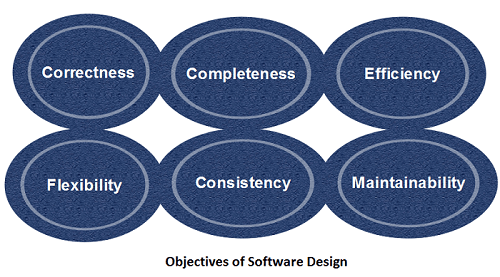
Objectives of Software Design
Following are the purposes of Software design:
Software Quality
What is Software Quality?
Software Quality shows how good and reliable a product is. To convey an associate degree example, think about functionally correct software. It performs all functions as laid out in the SRS document. But, it has an associate degree virtually unusable program. even though it should be functionally correct, we tend not to think about it to be a high-quality product. Another example is also that of a product that will have everything that the users need but has an associate degree virtually incomprehensible and not maintainable code. Therefore, the normal construct of quality as “fitness of purpose” for code merchandise isn’t satisfactory.
Factors of Software Quality
The modern read of high-quality associates with software many quality factors like the following:
- Portability: A software is claimed to be transportable, if it may be simply created to figure in several package environments, in several machines, with alternative code merchandise, etc.
- Usability: A software has smart usability if completely different classes of users (i.e. knowledgeable and novice users) will simply invoke the functions of the merchandise.
- Reusability: A software has smart reusability if completely different modules of the merchandise will simply be reused to develop new merchandise.
- Correctness: Software is correct if completely different needs as laid out in the SRS document are properly enforced.
- Maintainability: A software is reparable, if errors may be simply corrected as and once they show up, new functions may be simply added to the merchandise, and therefore the functionalities of the merchandise may be simply changed, etc
- Reliability: Software is more reliable if it has fewer failures. Since software engineers do not deliberately plan for their software to fail, reliability depends on the number and type of mistakes they make. Designers can improve reliability by ensuring the software is easy to implement and change, by testing it thoroughly, and also by ensuring that if failures occur, the system can handle them or can recover easily.
- Efficiency: The more efficient software is, the less it uses of CPU-time, memory, disk space, network bandwidth, and other resources. This is important to customers in order to reduce their costs of running the software, although with today’s powerful computers, CPU time, memory and disk usage are less of a concern than in years gone by.